Is India Ready for Large-Scale Chip Manufacturing?
PM Modi inaugurates Micron’s Gujarat chip plant. Is India ready for semiconductor manufacturing? Here’s the real picture on fabs, talent, and gaps.

On February 28, 2026, PM Narendra Modi inaugurated Micron Technology's chip plant in Sanand, Gujarat. It was the first time a commercial semiconductor facility opened on Indian soil. A historic moment — but it also raises a real question: is India actually ready for large-scale chip manufacturing?
What Has Happened So Far?
Until 2021, India was importing over 91% of its chips. The COVID pandemic made this painfully obvious — the auto industry alone had a backlog of 500,000 vehicles just because chips weren't available. That wake-up call pushed the government to launch the Semicon India Programme with an $8.7 billion budget. Four years later, $18.3 billion in semiconductor investments have been approved across 10 major projects in six states.
What Is Actually Being Built?
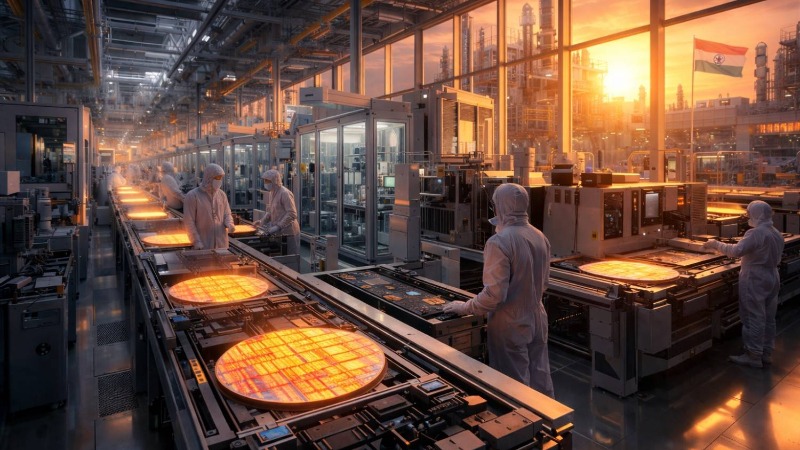
Tata Electronics + PSMC (Taiwan) — Dholera, Gujarat is the biggest project. A $10.9 billion wafer fabrication plant — India's first real chip factory — is under construction. Production is expected by late 2026.
Micron Technology — Sanand, Gujarat is already inaugurated. It's an assembly and packaging plant with a $2.75 billion investment, co-funded by the Indian government. It will produce DRAM and NAND chips.
CG Power + Renesas (Japan) — Sanand, Gujarat started commercial operations in mid-2025. It can handle 500,000 chip units per day, scaling to 14.5 million per day in its next phase.
RIR Power Electronics — Bhubaneswar, Odisha is India's first silicon-carbide chip plant — specifically built for EV and renewable energy chips. Construction begins in 2026.
HCL + Foxconn — Jewar, UP had its groundbreaking in February 2026, anchoring a major semiconductor hub near Delhi.
India's Biggest Strength: Design Talent
Here's something most people don't know — India already employs 20% of the world's chip design workforce. Companies like Qualcomm, Intel, AMD, and Samsung all have major design centers in Bengaluru, Hyderabad, and Pune. The government's Design Linked Incentive scheme has supported 24 chip design projects so far, covering everything from AI processors to satellite communication chips. Startups like Mindgrove, Signalchip, and Saankhya Labs are building chips entirely from India.
Global Companies Are Putting Real Money In
This isn't just talk. Applied Materials is investing $400 million. AMD is committing $400 million to R&D. Foxconn is putting $600 million into Karnataka. Lam Research is investing $25 million specifically to train 60,000 Indian engineers. When companies like these write nine-figure checks, it tells you something real about confidence in India's trajectory.
What the Government Just Did: ISM 2.0
In the Union Budget on February 1, 2026, Finance Minister Nirmala Sitharaman announced India Semiconductor Mission 2.0. The Electronics Components Manufacturing Scheme budget was raised to ₹40,000 crore — nearly double the original amount. The target: by 2029, India should be able to design and manufacture chips for 70–75% of its own domestic needs. By 2035, India wants to be among the top semiconductor nations in the world.
Where India Still Falls Short — Honestly
India is not ready for everything. The chips being built here are mostly mature-node chips (28nm and above) — the kind used in cars, appliances, and basic electronics. The world's cutting-edge chips (3nm, 2nm) are made by TSMC and Samsung, and India is nowhere near that yet. That gap won't close in five years — realistically, it's a decade-long journey.
India also doesn't yet make the equipment used to manufacture chips — the lithography machines, the deposition tools, the ultra-precise systems that actually build a chip. All of that is still imported from the US, Japan, and the Netherlands.
Power and water are real constraints too. A single chip factory can consume millions of gallons of ultra-pure water daily and needs absolutely uninterrupted electricity. India's infrastructure is improving, but it's not uniformly at that standard yet outside of Gujarat's industrial zones.
And while India has great chip designers, it doesn't yet have enough manufacturing floor engineers — the process specialists and clean-room technicians that factories need to run. Training pipelines are being built, but they take years to produce results.
So, Is India Ready?
For chip assembly, packaging, and legacy-node manufacturing — yes, or very close to it. The Micron plant is live. CG Power is operational. Tata's Dholera fab is on track for 2026. These are real facilities with real chips coming out.
For cutting-edge chip fabrication — not yet. And that's okay. The US, Japan, and South Korea spent 30–40 years building that capability. India is trying to compress that timeline significantly, and the early signs are credible.
The biggest tailwind India has is geopolitical. As the US-China tech rivalry reshapes global supply chains, every major company in the world is looking for an alternative to being over-concentrated in Taiwan and China. India is the most credible option. The money is coming. The plants are being built. The talent is already here.
The chips — literally and figuratively — are being placed on India.
Sources: India Semiconductor Mission (ISM), Press Information Bureau, Invest India, Union Budget 2026–27, ITIF Research (Jan 2025), Cornell SC Johnson College of Business (May 2025)


Why Are Oil Prices Rising Amid the Israel Conflict?
03 Mar, 2026
Middle East Tensions Rise: Is a Bigger War Coming?
01 Mar, 2026
Solo Travel Guide for Beginners
27 Feb, 2026
Desert Safari Experience in Rajasthan
27 Feb, 2026